









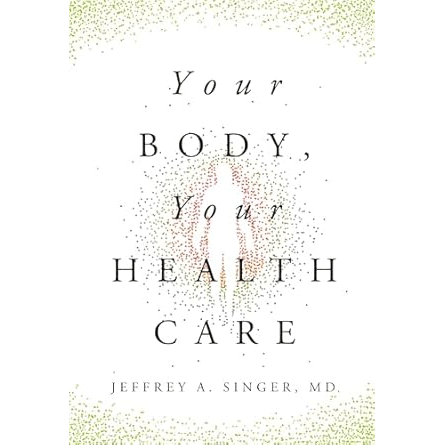
 In re-reading this essay of mine on New Year's Eve 2025, I was unhappy with the way that I seem to have "dived right in" to the shortcomings of Singer's book without first giving credit where credit's due. Singer is one of the least bamboozled drug pundits in America today. The reader should take that as a "given" as far as I am concerned. He certainly beats out a long list of rivals for that title, including DJ Nutt, Michael Pollan, Rick Strassman, Ralph Metzner, and Andrew Weil. Singer is that rare author who understands that drug prohibition is nothing less than the outlawing of our right to heal -- of our right to take care of our own health as we see fit, than which no other right can be more basic and fundamental.

"Much evidence confirms that long-term treatment with the opioid agonists methadone and buprenorphine is the most effective treatment for OUD [Opioid Use Disorder]." --Jeffrey A. Singer, from Your Body, Your Health Care, p. 1436
"The feeling was one of great camaraderie, and it was very easy to talk to people."
"It was a glorious feeling, and beauty was everywhere enhanced."
"I acknowledged a rapture in the very act of breathing."
This government-supplied drug will keep you from becoming a lazy Chinese a la the racist picture painted for us by mendacious missionaries in the 19th century, whose Big Lies about opium use in China taught us to mistrust and hate the drug in the first place, even though opium smoking in the west would cut down on alcohol use and so bring wife beating to an end.
"Sadly, staff at a London, Ontario, OPC experienced their first overdose fatality in early October 2024 after being unable to resuscitate an overdose victim." --Jeffrey A. Singer, from Your Body, Your Health Care, p. 14214
"The DEA added MDMA to Schedule I in 1985, after the drug became popular among rave concertgoers who called the drug 'ecstasy.'" --Jeffrey A. Singer, from Your Body, Your Health Care, p. 9618
"[Ketamine] creates a dissociative state by disconnecting patients' mental processes from their pain perception." --Jeffrey A. Singer, from Your Body, Your Health Care, p. 9521
"This feeling of detachment is the most important feature of opiate analgesia. As a deadening agent, opium has almost no effect. If measured purely for its ability to alleviate the sensation of pain, morphine 22 , opium, or any of the others would score no better than aspirin. It is the perception of pain that opium alters, and that makes all the difference in the world." --Jim Hogshire, from Opium for the Masses: Harvesting Nature's Best Pain Medication23
"The strong craving that characterizes opiate addiction has inspired many critics of the drugs to suggest that narcotics destroy the will and moral sense, turning normal people into fiends and degenerates. Actually, cravings for opiates are no different from cravings for alcohol among alcoholics, and they are less strong than cravings for cigarettes, a more addictive drug." --Andrew Weil, from From Chocolate to morphine 24 : Everything You Need to Know About Mind-Altering Drugs25
"Journalists, commentators, and lawmakers should use terminology more accurately and precisely, and resist the temptation to confer legitimacy on an unproven addiction." --Jeffrey A. Singer, from Your Body, Your Health Care, p. 11827
"No China resident believes in the terrible frequency of the dull, sodden-witted, debilitated opium smoker met with in print. " --William H. Brereton, from The Truth About Opium, quote from Dr. Ayers, the Surgeon General of Hong Kong in the early 19th century28
"The government forces thousands of Chinese whom it labels 'internet addicts' into psychiatric boot camps. It subjects them to forced medication and, sometimes, electroshock therapy." --Jeffrey A. Singer, from Your Body, Your Health Care, p. 11729
"It is much less harmful to consume cannabis than it is to consume alcohol. There is no lethal dose of cannabis, and no history of anyone dying from consuming too much of it. Cannabis is also less likely to lead to violent behavior than alcohol." --Jeffrey A. Singer, from Your Body, Your Health Care, p. 9332
"It is said that the Government must safeguard the health of the community. And the moment that is said, there ceases to be the shadow of a difference between beer and tea. People can certainly spoil their health with tea or with tobacco or with twenty other things. And there is no escape for the hygienic logician except to restrain and regulate them all. If he is to control the health of the community, he must necessarily control all the habits of all the citizens...." --GK Chesterton, from Eugenics and Other Evils35
"Imagine how many people would have benefited during the past half-century had the government respected their autonomy and their right to self-medicate." --Jeffrey A. Singer, Your Body, Your Health Care --p. 9736
"You have taken away my right to heal by outlawing drugs like cocaine that could have cured my depression in a trice, and instead shunted me off onto Big Pharma drugs that can NEVER be kicked 41. Where is your concern for the Big Pharma patients who can never get off their "meds", you who have always made such a big fuss about the evils of drug dependency?! How can you sit there and support a policy that has turned me into a drug user for life -- meanwhile denying me the obvious cure for depression that was championed by Sigmund Freud himself 42-- until self-interested doctors ignored the interests of hundreds of millions of the depressed by focusing only on the rare downsides of use? You have outlawed my most fundamental human right: my right to heal! And how? By taking away another equally fundamental right: my right to benefit from the bounty of Mother Nature!"
Almost every article about suicide is shallow because it takes drug prohibition as a natural baseline, even though drug prohibition outlaws substances that could so clearly elevate mood.
Materialist scientists cannot triumph over addiction because their reductive focus blinds them to the obvious: namely, that drugs which cheer us up ACTUALLY DO cheer us up. Hence they keep looking for REAL cures while folks kill themselves for want of laughing gas and MDMA.
Many psychonauts (like Terence McKenna) praise psychedelics while demonizing other psychoactive substances. No substance is bad in itself. All substances have some use at some dose for some reason for some people in some circumstance.
I'm told antidepressant withdrawal is fine because it doesn't cause cravings. Why is it better to feel like hell than to have a craving? In any case, cravings are caused by prohibition. A sane world could also end cravings with the help of other drugs.
In "Four Good Days" the pompous white-coated doctor ignores the entire formulary of mother nature and instead throws the young heroin user on a cot for 3 days of cold turkey and a shot of Naltrexone: price tag $3,000.
My impression has been that the use of cocaine over a long time can bring about lasting improvement..." --Sigmund Freud, On Cocaine, 1884
Why don't those politicians understand what hateful colonialism they are practicing? Psychedelics have been used for millennia by the tribes that the west has conquered -- now we won't even let folks talk honestly about such indigenous medicines.
Most enemies of inner-city gun violence refuse to protest against the drug prohibition which caused the violence in the first place.
Drug prohibition is superstitious idiocy.
It is based on the following crazy idea:
that a substance that can be misused by a white young person at one dose for one reason must not be used by anybody at any dose for any reason.
We need to stop using the fact that people like opiates as an excuse to launch a crackdown on inner cities. We need to re-legalize popular meds, teach safe use, and come up with common sense ways to combat addictions by using drugs to fight drugs.

 (up)