









"We don't know how antidepressants work." --Noam Shpancer Ph.D., from Depression Is Not Caused by Chemical Imbalance in the Brain29
"The evolution of modern medicine gave us our current, bifurcated view of drugs: the good ones that treat illness and the bad ones that people use to change their minds and moods.32"
"Scientific thinking, a thinking which looks on from above, and thinks of the object-in-general, must return to the 'there is' which underlies it; to the site, the soil of the sensible and opened world such as it is in our life and for our body -- not that possible body which we may legitimately think of as an information machine but that actual body I call mine, this sentinel standing quietly at the command of my words and my acts."
--Alden L. Fisher, from The Essential Writings of Merleau-Ponty33
"Assumed powers of anticipating the future or of telepathic communication with other minds are, [Kant] says, concepts '...the possibility of which is altogether groundless, as they cannot be based on experience and its known laws, and without such confirmation are arbitrary combinations of thoughts, which, although indeed free from contradiction, can make no claim to objective reality and so to the possibility of an object such as we here profess to think.'" --Norman Kemp Smith, A Commentary to Kant's Critique of Pure Reason39
"Our normal waking consciousness, rational consciousness as we call it, is but one special type of consciousness, whilst all about it, parted from it by the filmiest of screens, there lie potential forms of consciousness entirely different. We may go through life without suspecting their existence; but apply the requisite stimulus, and at a touch they are there in all their completeness, definite types of mentality which probably somewhere have their field of application and adaptation. No account of the universe in its totality can be final which leaves these other forms of consciousness quite disregarded." --William James, The Varieties of Religious Experience40
 In a sane world, the ideas of James regarding the so-called 'anesthetic revelation 41 ' 42 would open up a whole new world of research on the supposed sufficiency of the Kantian categories43, but philosophers refuse to "go there" because they know it is literally against the law to do so. It would mean at very least that they would have to publicly protest drug prohibition as necessarily involving the censorship of academia, and this they will never do, either because they fear the consequences of doing so, or else they share the superstitious belief of the Drug Warrior that drugs can be evil in and of themselves without regard for how or why they are used. These philosophers have, after all, like all of us, been brainwashed in this belief since grade school, above all by the propaganda of censorship, thanks to which they never see the positive depiction of any sort of drug use whatsoever, neither in magazines, movies 44 45 nor on TV shows 46 , this despite the fact that drugs have inspired entire religions47 and that most drugs are far less inherently dangerous than alcohol, which kills 178,000 a year in America alone48.
"In unattended calibrations all of these sophisticated machines produced strictly random data, yet the experimental results display increases in information content that can only be attributed to the consciousness of their human operators." -- Scientific Study of Consciousness-Related Physical Phenomena53
"Humph! It's rather boorish of you, old boy, to discuss matters of such obvious relevance to daily life in this elite forum of ours! We are professional philosophers after all, speaking of abstruse matters, sniff-sniff! Besides, drug prohibition only outlaws those drugs that produce states of mind about which we materialist philosophers are not interested in any case, so where precisely is your problem, old boy?"
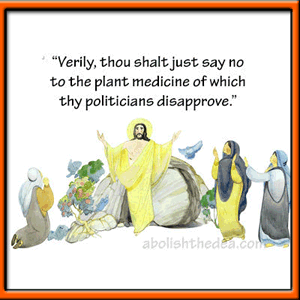 Many psychonauts (like Terence McKenna) praise psychedelics while demonizing other psychoactive substances. No substance is bad in itself. All substances have some use at some dose for some reason for some people in some circumstance.
I've been told by many that I should have seen "my doctor" before withdrawing from Effexor. But, A) My doctor got me hooked on the junk in the first place, and, B) That doctor completely ignores the OBVIOUS benefits of indigenous meds and focuses only on theoretical downsides.
"Judging" psychoactive drugs is hard. Dosage counts. Expectations count. Setting counts. In Harvey Rosenfeld's book about the Spanish-American War, a volunteer wrote of his visit to an "opium den": "I took about four puffs and that was enough. All of us were sick for a week."
Democratic societies need to outlaw prohibition for many reasons, the first being the fact that prohibition removes millions of minorities from the voting rolls, thereby handing elections to fascists and insurrectionists.
When the FDA tells us in effect that MDMA is too dangerous to be used to prevent school shootings and to help bring about world peace, they are making political judgments, not scientific ones.
Rather than protesting prohibition as a crackdown on academic freedom, today's scientists are collaborating with the drug war by promoting shock therapy and SSRIs, thereby profiting from the monopoly that the drug war gives them in selling mind and mood medicine.
We drastically limit drug choices, we refuse to teach safe use, and then we discover there's a gene to explain why some people have trouble with drugs. Science loves to find simple solutions to complex problems.
The Shipiba have learned to heal human beings physically, psychologically and spiritually with what they call "onanyati," plant allies and guides, such as Bobinsana, which "envelops seekers in a cocoon of love." You know: what the DEA would call "junk."
Jim Hogshire described sleep cures that make physical withdrawal from opium close to pain-free. As for "psychological addiction," there are hundreds of elating drugs that could be used to keep the ex-user's mind from morbidly focusing on a drug whose use has become problematic for them.
The drug war is a meta-injustice. It does not just limit what you're allowed to think, it limits how and how much you are allowed to think.


 (up)