Welcome to 'What's My Line: Drug War Edition.' Here is your host, Blaze Thunderstone.
Today's mystery guest is Andy from Staten Island, New York. Andy, how are you doing today?
Great, Blaze, thanks.
Let's ask some questions to see if our contestants can figure out what you do for a living. Fire when ready, Mary.
Does your job have anything to do with breaking down doors and throwing grandmothers to the floor?
You might say that, yes.
Very interesting. Steve?
If I begged for mercy while you were ransacking my house, would you be likely to cut me some slack?
Ha, you wish.
I think we'll take that as a no. Harmony, your question, please.
If you broke down my door and I did not immediately get down on the floor, would you shoot me?
Of course. You would have it coming to you, in that case.
Time is up, I am afraid. Mary, what do you think that Andy here does for a living?
It's hard to say, however, I think he might be a member of the Nazi Gestapo.
Oh, close one, Mary, but that is not quite the correct answer. Steve?
Is Andy one of those mindless thugs who goes around enforcing protection rackets for the Mafia?
Oh! Once again, that's very close, but it is not the precise answer that we are looking for. Harmony, what do you think is Andy's job?
Well, if he is not in the Gestapo and he is not part of the Mob... is he one of those DEA agents who destroys houses on a whim and answers to nobody, thereby constituting an abomination in a supposedly free country?
Exactly, Harmony, well done. Yes, Andy is indeed one of those D E A agents who destroys houses on a whim and answers to nobody, thereby constituting an abomination in a supposedly free country!
You have been listening to What's My Line, Drug War edition, with your host, Blaze Thunderstone.
To oppose the Drug War philosophically, one has to highlight its connections to both materialism and the psychiatric pill mill. And that's a problem, because almost everyone is either a Drug Warrior or a materialist these days and has a vested interest in the continuation of the psychiatric pill mill.
My impression has been that the use of cocaine over a long time can bring about lasting improvement..." --Sigmund Freud, On Cocaine, 1884
The drug war controls the very way that we are allowed to see the world. The Drug War is thus a meta-injustice, not just a handful of bad legal statutes.
FDA drug approval is a farce when it comes to psychoactive medicine. The FDA ignores all the obvious benefits and pretends that to prove efficacy, they need "scientific" evidence. That's scientism, not science.
Our government treats drugs like uranium and spends hundreds of billions of dollars trying to scare us about them.
"Chemical means of peering into the contents of the inner mind have been universally prized as divine exordia in man’s quest for the beyond... before the coarseness of utilitarian minds reduced them to the status of 'dope'." -- Eric Hendrickson
Do drug warriors realize that they are responsible for the deaths of young people on America's streets? Look in the mirror, folks. People were not dying en masse from opium overdoses when opiates were legal. It took your prohibition to accomplish that! Stop arresting, start teaching safe use!
America takes away the citizen's right to manage their own depression by making opium and cocaine illegal. Then psychiatrists treat the resulting epidemic of depression and anxiety by damaging the patient's brain with shock therapy.
When is the Holocaust Museum going to recognize that the Drug War has Nazified American life? Probably, on the same day that the Jefferson Foundation finally admits to having sold out Jefferson by inviting the DEA onto his estate in 1987 to confiscate his poppy plants.
The drug war is a whole wrong way of looking at the world. It tells us that substances can be judged "up" or "down," which is anti-scientific and blinds us to endless beneficial uses.
Break the ice with a sledgehammer: place this book on your coffee table.
This book features 150 annotated images, designed to force brainwashed Americans to confront the fact that drug prohibition is wrong. Here is what author Richard Parrish II says of the book's compiler: "The drug prohibition philosopher provides first-hand, principled, persuasive, and insightful arguments against the current drug prohibition regime..."
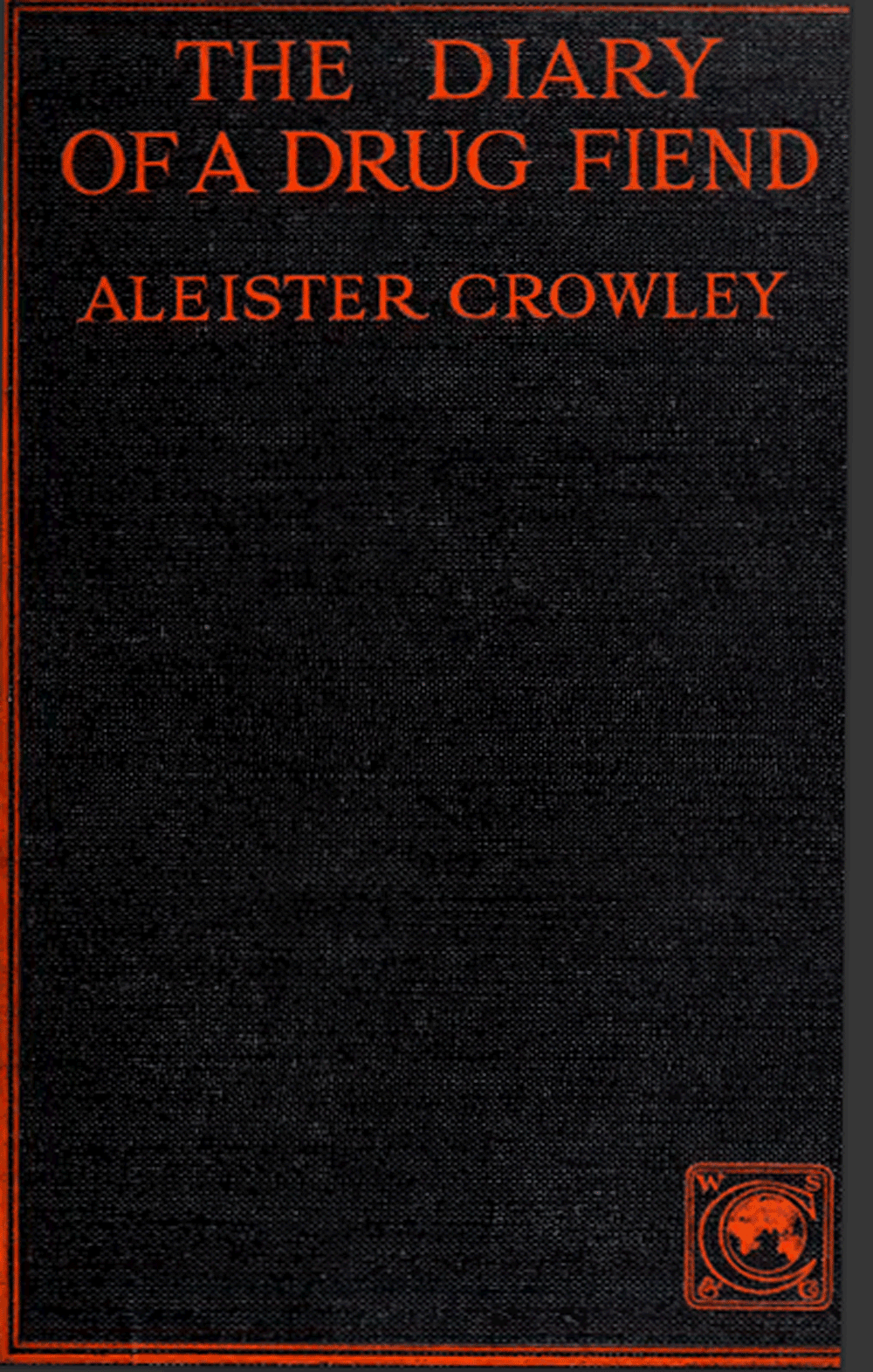
This is the only full-cast recording of Aleister Crowley's 1922 classic paeon to common sense. It is the first book -- and so far almost the only book -- to stake out a philosophy of drug use that is compatible with human freedom, one in which we learn to use drugs as wisely as possible for the benefit of humanity. This recording was produced by the Drug War Philosopher and your purchases help support his effort to push back against the tragically counterproductive policy of drug prohibition, in the name of human freedom and of humanity's right to heal.
No cookies, no ads paid for by amoral and immoral billionaires (or trillionaires).
Unless otherwise indicated, no AI is used in the creation of site content. These essays represent the original ideas of their author and not the ideas that the author SHOULD have based on an algorithmic parsing of existing data. For more on this subject, consider the AI-related viewpoints to which the author subscribes as delineated in the New York Times opinion piece entitled "What 370,000 College Essays Tell Us About A.I.’s Effects on Creativity" by Rebecca Winthrop of the Brookings Institution.











 (up)
(up)