Introduction to the Drug War Philosopher Website at AbolishTheDEA.com
by Ballard Quass, the Drug War Philosopher
January 18, 2025
April 18, 2026
For those of you who would like to dismiss my essays as subjective rant... a word about my modus operandi. In these essays, I make use of the argumentum ad absurdum, in which one adduces a variety of generally accepted propositions and then deduces the illogical consequences of those propositions, thereby displaying the inanity of our widely held beliefs.
January 21, 2026
I was going to take a day off from writing about the crime against humanity known as drug prohibition... and then I saw an article in The New York Times that pushed my last and final button, a piece by healthcare reporter Stephanie Nolen entitled Claire Brosseau Wants to Die. Will Canada Let Her?1
I pray you will read this message. I have a "take" on these subjects that routinely leaves me "ghosted" by the media.
Americans have been taught to superstitiously believe that drugs are bad. Drugs are not bad or good. They are inanimate objects. Their widespread misuse tells us something about society, not about drugs.
I am a 67-year-old philosopher who has been studying America's attitude about drugs for the last seven years. One of my conclusions has been that Americans "reckon without drug prohibition." They take it as a natural thing that we outlaw almost all psychoactive medicines, and therefore they fail to see facts that would otherwise be quite evident to them. Your story about Claire Brousseau, if you'll pardon me, is a case in point. The issue in the Claire Brousseau case should not be the right to die, but the time-honored right for the depressed to take care of their own health as they see fit. In other words, we should be having a national debate about drug prohibition, not about assisted suicide.
The right to take care of one's own health has always been a fundamental right in all countries, until the American healthcare industry, in lockstep with racist politicians, strove to demonize panaceas like coca and opium for self-interested reasons. Claire would have the right to die today if she were simply allowed to use Mother Nature's medicines, especially opiates -- a time-honored right that ended in the early 1900s when racist politicians outlawed such drugs for xenophobic reasons -- with doctors piling on with anti-drug op-ed pieces for obvious financial reasons. Young people were not dying in the streets when opiates were legal in America, however; it took drug prohibition to accomplish that by creating a market for stronger, unregulated opiates.
Of course, without drug prohibition, Claire would have also had the right to live fully, since there are hundreds of drugs that we know about, even today, that could be used wisely with psychologically obvious protocols to keep most people from committing suicide. We do not realize this, partly because of media censorship, and partly because our Christian Science government will not spend a penny on developing common-sense protocols for using drugs that inspire and elate. You say "she tried drugs," as if that whole approach failed, but "drugs" is a vast category of substances that have been slandered and demonized by racist politicians and about which we have been shielded from all reports of positive use. These substances have nothing in common as a class except that they tend to inspire and elate -- a sin for which beer-bellied Christian politicians can never forgive them.
Did Claire try laughing gas that gives users glimpses of heaven? Did she try the kinds of phenethylamines synthesized by Alexander Shulgin? Did she try the many "teacher plants" of the rainforest that Americans would rather eradicate from the face of the Earth than to use wisely for the benefit of humanity? Did she try the kinds of drugs that have inspired entire religions? There are drugs that can cheer us up and inspire us in a trice -- like the cocaine that Sigmund Freud advocated for the depressed -- and if Claire does not respond positively to ANY of them, she is a very unique individual, indeed, so much so as to be totally unrepresentative of depressed people in general. Speaking for myself, I would consider it a heaven-sent blessing to be able to use laughing gas, opium or coca, say, once a week. Merely looking forward to the use would cheer me up! This for me is psychological common sense.
Unfortunately, the materialist scientists in the healthcare field of the west do not judge drugs holistically, and so they are allowed to ignore common sense. And so they gaslight the depressed by telling us that such medicines do not "really" work, which is just a metaphysical assertion on their part, based on the supposed correctness of the philosophy of materialism. (Apparently, in order to really work, you have to cause a lifelong dependency with regular use, as do many modern antidepressants.) This attitude represents a kind of pharmacological colonialism, given that indigenous people have judged drugs holistically for millennia (the same indigenous people whom the west has conquered and forced to accept alcohol as their drug of choice).
I feel strongly about this because I have skin in this game. As a chronic depressive myself, I too have wanted to die many times -- but I decided to live to spread the news that I have been a victim of drug prohibition -- a message that no one seems ready to hear because they believe that science has "solved" depression and that I should just shut up and take my meds. The Claire Brousseaus of the world are now pointing out (albeit by implication only) that the emperor is wearing no clothes when it comes to the supposed "miracle drugs" of psychiatry. Unfortunately, however, Claire herself has been indoctrinated in the drug-hating religion of the Drug War and so she fails to see that drug prohibition is the real evil here, not her inability to take advantage of a specific law about assisted suicide.
Indeed, if I were to give Claire one piece of advice, it would be that she continue to live, devoting the rest of her time and energy to ending drug prohibition, which denies her the right to heal (to say nothing of her right to die). The depressed need the time-honored right to take care of their own health as they see fit. They do not need some new recherché and unprecedented right to order the government to kill themselves!!!
I used to think that drug prohibition was supposed to save me from horrible drugs like opium and coca, the drugs about which my media never allowed me to see, read or hear anything positive whatsoever. But what did drug prohibition really do? Drug prohibition shunted me off onto a drug that is far harder to kick than heroin -- a drug which is overpriced and underperforming (yet one that is still featured on the Mayo.com website as some kind of miracle worker)! My drug Effexor has a 95% recidivism rate for long-term users. 95%! Compare this with heroin, the drug we love to hate. Only 5% of the heroin-using soldiers in Vietnam needed help getting off the drug when they returned to the States! 5%. (See the Lee Robins study.)
That's right, our politicians lie to us about drugs... and the few true things that they say are never put in the proper context.
Sigmund Freud knew that cocaine was a godsend for the depressed. He wrote a whole book about it! Unfortunately, the self-interested doctors of his time judged the drug only by its downsides, exactly as if they were to judge alcohol by studying only alcoholics. As Wade Davis reported last year in Rolling Stone (April 2025), doctors originally blamed cocaine for causing toxicity in 400 users worldwide. 400. Wade implies that this was sufficient reason to outlaw cocaine. What Wade fails to realize, however, is that aspirin kills 3,000 people a year in the UK alone! 3,000! And that alcohol kills 178,000 in the US alone! 178,000!
Why are we so worried about those 400 users who were irresponsible or genetically contraindicated as to cocaine use! Why do we not worry at all about the HUNDREDS OF THOUSANDS like myself who suffer the hell of depression totally unnecessarily because our country has outlawed a drug based on the supposed interests of only one demographic! The depressed are never considered stakeholders when Americans talk about drug prohibition! (Of course, Rolling Stone ignored my letter to the editor on this subject -- as well as my follow-up letter in which I politely asked them why they had done so.)
And what about MDMA? This drug brought unprecedented peace and love to the dance floors of Britain in the 1990s and showed great promise in ending PTSD for American soldiers back from Iraq and Afghanistan, and yet the FDA does not consider MDMA to be safe enough for legal use? What? This is the same FDA that thinks that it's safe to have one's brain damaged by shock therapy! This is the same FDA that approves of Big Pharma drugs whose publicly advertised side effects include death itself! Wouldn't it break a heart of stone?
The real moral of Brousseau's story is that drug prohibition disempowers patients -- not just about suicide, but about everything!
Take me, for instance. Not only has psychiatry turned me into a ward of the healthcare state, but I cannot even get the drug that I now need (that my biochemistry now REQUIRES) without seeing a nurse who is 1/3rd my age every three months of my life to tell her about my private innermost feelings and to answer a long list of invasive and humiliating questions. I could live to 100 and the healthcare industry would still not consider me adult enough to take my medication (drugs) wisely. I have been turned into a child because of drug prohibition. And when I speak up about it, I am deemed a disrespectful troublemaker, exactly as if I were a first-grader who had talked back to his teachers.
Meanwhile, psychiatrists continue to recommend brain-damaging shock therapy for the depressed -- shock therapy -- when they should be fighting on behalf of their patients' right to heal by demanding the end to drug prohibition, a policy which outlaws all the drugs that could make shock therapy unnecessary!
This absurdity comes to new heights with the Brousseau case. We now want to write new laws that further normalize drug prohibition by pretending that it does not even exist! It is exactly as if we had outlawed antibiotics, and those who were suffering from this law were demanding the right to die, when they should actually be demanding the right to use the drugs that would help them want to live!
Am I the only one who sees the monstrosity of this mindset: that we would actually prefer that a depressed person undergo brain damage and commit suicide than to use the politically created boogieman called "drugs"? Has propaganda and censorship really made Americans that blind to common sense?
Brousseau's psychiatrists should not be fighting for her right to die. They should be fighting for the right of the depressed (and everyone else) to treat their own health as they see fit without the approval of the government and the healthcare industry.
Personally, I consider it to be a crime against humanity that I have spent my entire life now as a ward of the healthcare state thanks to drug prohibition, unable to make wise use of drugs that could cheer me up in a trice, many of which grow at my very feet! This is why I was so disappointed to see that no one -- not even Claire herself -- connects the dots between her own situation and America's unprecedented wholesale outlawing of psychoactive substances.
Thanks for "listening"...
PS I'm sure I have already overstayed my welcome, but here is some crucial information for the Claire Brousseaus of the world: those who dismiss "drugs" prematurely, as if "drugs" were one specific thing that they have found and tried and discovered to be ineffective in their case.
LAUGHING GAS: William James described how the use of laughing gas gave him glimpses of new realms and new possibilities. He considered it mandatory that we study such states of consciousness to understand the nature of reality itself! And yet the FDA wants to treat the gas like a drug, even though it is already shamefully unavailable to the suicidal, as a practical matter. (James' alma mater, Harvard University, has edited James' online bio so his work with nitrous oxide is not even mentioned!)
COCAINE: Sigmund Freud considered cocaine to be a godsend for the depressed. The Inca and their descendants have chewed the coca leaf nonstop for hundreds of years for endurance, inspiration, to fight hunger pangs, etc.
OPIUM: Many doctors in the 1800s considered nightly opium smoking to be a far better habit than the nightly consumption of alcohol. Read "The Truth about Opium" by William Brereton to learn more. The Anti-Opium Society in England was inspired and motivated by a bald-faced lie of an American missionary who claimed that two million Chinese died each year from smoking opium. The real total was closer to zero. It was certainly far below the death toll that could have been attributed to alcohol back then, either in the States or in England.
SOMA: This drug, or drugs, inspired the Vedic -- and hence the Hindu -- religion.
PHENETHYLAMINES: Chemist Alexander Shulgin synthesized a variety of phenethylamines in the early 1990s, for which user reports contained such testimony as:
"More than tranquil, I was completely at peace, in a beautiful, benign, and placid place."
"A glimpse of what true heaven is supposed to feel like... A true healing potential."
"This is total energy, and I am aware of my every membrane. This has been a marvelous experience, very beautiful, joyous, and sensuous."
And yet both psychiatrists and their patients seem to think that it's better to damage one's brain or to commit suicide than to use such substances.
And suppose we let Claire smoke an opium pipe every night or use cocaine daily like Sigmund Freud. Why do we consider that a fate worse than death in a world in which 1 in 4 American women take a Big Pharma med every day of their life... and we tell them that it's their medical duty to do so!!!
Claire is really spreading the worst lie yet about drug prohibition. She is helping to normalize drug prohibition even further by telling the depressed that there is no help for some of them, even if drugs were relegalized -- and that is simply not true! It can only be maintained by someone with a shallow grasp of what drugs can do (and have done in the past) for the benefit of human beings -- someone who was raised in a country that harshly suppresses such knowledge, such that libraries are full of books about drug abuse and misuse and almost totally void of books about positive ways to use drugs for psychological benefit. Let's give Claire the same rights that were possessed by Sigmund Freud and Marcus Aurelius and Benjamin Franklin, to use drugs daily for human benefit.
It is impossible that no drugs could help Claire. Impossible. The human brain, as scientists well know, is specifically designed to benefit from drugs. In a world wherein we did not demonize drugs a priori and were patient and compassionate, we would find drug protocols that worked for Claire, in a world I mean where every possible drug (or drug combination) were once again legal to use. Americans are only now waking up to the fact that the world is full of psychoactive medicines -- a fact that indigenous people have always known. Unfortunately, many modern drug pushers know more about this potential than do materialist psychiatrists, who have this bizarre idea that symptomatic relief is evil -- as if it were evil to relax at night with a glass of wine.
What's the result of this viewpoint? 1 in 4 Americans are shunted off onto lifetime dependency with the "real" cures of psychiatry. No wonder they still want to commit suicide. It is humiliating to be an eternal patient on a drug that VASTLY underperforms all the substances that America has outlawed for racist and political reasons.
Psychiatrists on X tell me it's wrong to even discuss antidepressants honestly because it might keep people from taking them. That's very convenient for them, of course. But they seem to have less problems with people suggesting that suicide is better than the use of evil "drugs." Something is very wrong with this picture -- and it is all caused by drug prohibition and the childish (almost willful) ignorance about drugs that it promotes. It is all about our refusal to let Americans make the big decisions about their own health once again, rather than putting those decisions in the hands of the legal system.
I have been studying drug prohibition from a philosophical angle for the last seven years. During this time, I have been shocked to see how many authors and philosophers absolutely refuse to discuss drug-related topics. The vast majority will not even acknowledge receipt of an email on these topics. That is why I appreciate folks like yourself who speak out.
I take drug prohibition personally because it has outlawed the medicines that could have helped me as a chronic depressive, meanwhile shunting me off onto Big Pharma meds that are far harder to kick than heroin! In fact, the particular "med" THAT I'm on has a 95% recidivism rate for long-term users. 95%! And yet no one considers me to be a victim of the Drug War. They seem to think that I should just shut up and take my meds. Moreover, the government requires that I see a doctor half my age every three months of my life for the privilege of BUYING those overpriced and underachieving meds. I can never be trusted to use even Big Pharma drugs wisely, not even at the age of 67! And so drug prohibition has turned me into a demoralized child, a ward of the healthcare state and (irony of ironies) into a lifetime drug user.
This is just one of the many downsides of drug prohibition that so few people seem to recognize. In fact, the biggest "finding" that I've come away with from my study of America's drug attitudes is that almost no one appreciates the full list of downsides to drug prohibition, almost no one at all. Not only does drug prohibition turn adults into children as in my case, but it censors academia and authors to the point where books about wise and beneficial drug use scarcely even exist. The sad thing is that most authors censor themselves, however. They have been bamboozled by the full-court press of drug propaganda and the censorship of all positive reports of drug use in the media. To say nothing about the TV shows and movies which never show drug use in a positive light -- but will be glad to promote reckless drinking and "taking your meds."
If you're interested in learning more on my philosophical conclusions, I invite you to visit my totally shunned website at abolishthedea.com. I especially call your attention to my virtual "museum of the Drug War" at:
There you will see an exhibition that will never be shown in America -- because it raises issues that even progressive museum curators are terrified of addressing openly and honestly.
Thanks again for your work against the hateful policy of drug prohibition.
UPDATE TWO January 2025
Well, I have been studying the philosophy of the Drug War for seven years now and I have reached some unhappy conclusions. I have found that Americans really are completely bamboozled on the subject. Completely. I have found, in short, that propaganda works. What can we expect from a people who have been shielded since childhood from all reports of positive and beneficial drug use? There are endless ways that spirit-lifting drugs could help specific individuals to thrive in life (such ways are just common psychological sense), and yet we are simply not allowed to speak of such things. We even edit history in order to accord with our drug-hating views, and so biographies of Ben Franklin ignore his opium use and students of Freud are scarcely told of his advocacy of cocaine for the depressed. If we are, we are quickly told that that was a huge mistake on Freud's part23. And why? Because 400 people in Freud's time misused the drug due to irresponsibility and/or genetic predisposition. 400 people. And yet aspirin itself kills 3,000 people every year in the UK alone4. No one cared about the hundreds of thousands of chronically depressed Americans who could have been cheered up in a trice with the help of an alkaloid from the Divine plant of the Incas.
Freud knew that cocaine was a godsend for the depressed. But doctors saw it as a threat to their bottom line and so they studied only the rare misuse of the drug.
No, instead American racists encouraged the UN to adopt the outrageous goal of eradicating coca from the face of the Earth5. What xenophobic presumption! What racist childishness! What superstition, even! Scientists should have bristled at the sheer chop-logic of that mad idea and demanded their right to academic freedom regarding naturally occurring medicines. Instead, they joined with the medical industry in remaining silent. Worse yet, many of them went on to help normalize drug prohibition by gaslighting Americans, telling them that drugs that cheer you up do not "really" work, and that you need scientifically created pills6. What scientifically created pills? The ones that turn you into a patient for life and are harder to kick than heroin, the pills that were promoted on the lie that they fix a chemical imbalance in the brain, a claim that even scientists now reject7. Indeed, the pills seem to cause chemical imbalances, which is the only explanation for the unprecedented difficulty that long-term users find in kicking the drugs8.
Cui bono? The medical industry for starters, which would be half its size today were Americans still allowed to take care of their own health, which is really the most basic right of all9.
American soldiers used heroin regularly in Vietnam, yet only 5% required help getting off the drug when they returned to the Prohibition Republic of America. Five percent.10 Compare this to Big Pharma drugs like Effexor/Venlafaxine, which have a 95% recidivism rate for long-term users -- a number which I think is generous based on my own experience of hell in trying to quit the drug on a slow and tapered basis last year11.
I can also say that I know of no modern drug pundit today who appreciates the full evil of drug prohibition. Most pundits still write as if poor little vulnerable white children are the only stakeholders in the drugs debate -- as if all we have to do is to outlaw the drugs that they might use and Bob's your uncle. This is selfishness on an epic scale, however, selfishness which ignores the young people killed by drive-by shootings, the depressed who are denied their right to heal and shunted off instead onto "meds" that are far harder to kick than heroin, and the young pain patients in hospice who go without adequate pain relief because doctors know that bureaucrats in Washington DC are looking over their shoulders, ready to second guess their decisions based on an ad hoc collection of puritanical and political presuppositions.
Most hospitals in India no longer carry morphine thanks to the Drug War. Fearmonger Americans have so demonized the drug that it is too expensive and difficult to administer, even to children in hospice care.
The real lesson of my seven years' research is that drug prohibition kills, not drugs: that drug prohibition must be recognized as evil in itself. Yet despite the bloody and hugely counterproductive results of a century-long crackdown during which drug use has skyrocketed and become far more dangerous than ever, Americans still cling to their idee fixe, to their repeatedly disproved notion that harsh legislation is the answer to every social problem on earth.
But I have made such arguments in a thousand different ways from a thousand different perspectives and been ignored every time. So these words will have to sit here and wait for just enough sanity to prevail in America that people at least dare to read essays that run counter to the prevailing ideology of substance demonization.
For it cannot be said enough -- at least until someone dares to hear -- that saying things like "Fentanyl kills!" is philosophically equivalent to shouting "Fire bad!" Both statements would have us fear dangerous substances rather than learn how to use them wisely for the benefit of humanity12.
I can only join with the late great Thomas Szasz, the only American who seemed aware of the philosophical absurdity and anti-democratic ramifications of drug prohibition, in hoping that Americans will eventually wake up and stop acting like children when it comes to the subject of drug use. They treat all other dangerous activities calmly and rationally, like mountain climbing, free diving, car racing, and tightrope walking. But like Don Quixote, they become childish and mad on their pet subject, in this case the subject of drugs. Often they evoke the bugaboo of unwanted dependence -- which, of course, is hugely ironic given that it is drug prohibition itself which "saved" depressed Americans from statistically harmless cocaine by shunting them off onto Big Pharma meds that are FAR FAR HARDER TO KICK THAN HEROIN.
UPDATE January 2025
Imagine a book in which the preface is longer than the text that follows it. That is precisely what this site introduction is turning into. I keep thinking of crucial insights that the casual viewer should immediately see and which I dare not bury at the end of the lengthy screed that follows, lest it be completely ignored. Take today, for instance. I have had the following epiphanies on the topic in question. (Are you a student or teacher? I dare you to discuss these topics openly in class! Go on, I dare you!)
1) Companies like to use drug testing because it helps ensure that the employees that they hire are docile and ready to give up their fundamental rights to corporations. In other words, drug testing helps weed out applicants who have a mind of their own. When lab technicians flag "drug use," what they are really flagging is "free thinking."
2) The Drug War can be called The Tyranny of Worried Parents. Parents self-righteously demand drug prohibition laws after their kids misuse a drug, and this is massively selfish of them. Why? Because they are not the only stakeholders when it comes to drugs. When they outlaw a drug based on their own life story, they are outlawing the drug for the depressed, for those in pain, for those seeking mental and spiritual inspiration, for those seeking to follow up on the investigations of William James with respect to the nature of consciousness and reality. They outlaw future medicines that may contain the drug in question or be inspired by its chemical structure, etc. They outlaw, in fact, the kinds of drugs that have inspired entire religions, which is to say, drugs that inspire and elate. Moreover, when they outlaw a naturally occurring drug based on their own life story, they are outlawing farming practices around the globe and the ability of people thousands of miles a way to make a living. Meanwhile, they are incentivizing the kind of violence that destroys entire communities both at home and abroad.
In other words, drug prohibition is massively selfish.
This is but one of many drug-related insights that you will search for in vain in your local library.
Don't think your life has been censored? Look for books about wise and beneficial drug use in your local library!
PREFACE December 2025
This introduction page is turning into a blog, but I fear that transformation was inevitable. My ongoing philosophical study of American drug attitudes is constantly refining my conclusions and I always fear that my readers (my very few readers, alas) will leave my site with a mangled view of my overall position on these topics, one based, perhaps, on their chance reading of an essay of mine in which I permitted my emotions to obscure the basic philosophical points that I was attempting to highlight and to address. I cannot, however, apologize entirely for such emotions because I have "skin in this game." When I discuss American (and western) drug attitudes, I am not just discussing theoretical niceties, like the few other philosophers who might dare to address these issues (although some of the issues that I raise in my drug-related essays have never been addressed by anybody at all, to my knowledge, let alone a philosopher), but I am addressing dogmatic points of view that, in serving to "justify" a host of tyrannical laws and policies, have forced me to go a lifetime without godsend medicines, have denied me my right to heal, have turned me into a patient for life, and have kept me from following in the footsteps of William James when it comes to the study of ultimate reality13. I feel that I am justifiably upset about these deprivations – and what's more, I am upset about the fact that nobody else is upset, if only on the grounds of the loss of their academic freedom. Unfortunately, the unsympathetic reader will be glad to take the resultant overlay of vehemence and urgency in my essays as "proof" that I am "disgruntled" and so use my anger as an excuse to ignore my philosophical conclusions rather than respond to them. Hence my perceived need to keep this introduction up-to-date, philosophically speaking, so that I can separate the wheat from the perceived chaff in my arguments and so forestall my critics in their attempts to discredit me.
Drug Free Zones are unconstitutional. They are the enforcement of Christian Science sensibilities, outlawing our right to heal. We might just as well have Press Free Zones, in which the freedom of the press does not apply.
At the risk of self-aggrandizement, I find I have much in common here with Immanuel Kant1415. He took up what he considered to be a philosophically crucial battle late in life after being roused from his "dogmatic slumbers" by the works of David Hume16. I, too, have taken up what I consider to be a philosophically crucial battle late in my life after being roused from my "dogmatic slumbers" by the works of Thomas Szasz17. But the similarities do not stop there. Like Kant, I am performing this self-assigned research project over a relatively long period of time and so my precise views on the subjects involved are adapting and modifying over time. The reader who fails to take this fact into account in either of our works will triumphantly conclude that they have discovered inconsistencies therein, failing to realize that, in both cases, they are reading a work in progress and that the goal of the reader is to grasp the unifying postulates that underlie the entire message, so to speak, rather than seeking for pedantic excuses to ignore the work as a whole. Indeed, Kant is arguably an easier target than I am for such sniping. As Kant translator Norman Kemp Smith observes in his authoritative Commentary: "Kant flatly contradicts himself in almost every chapter; and... there is hardly a technical term which is not employed by him in a variety of different and conflicting senses."18 For my part, I try to be consistent with my terminology, but it is difficult in a world in which Drug Warriors have coopted neutral words like "drugs19" and "addiction20" and tinged them with moral judgments. Before opium was outlawed in 1914, nightly opium smokers were considered habitues; after 1914, they became "addicts," with all of the moral and societal baggage that the term now implies.
In some ways, however, Kant and I are worlds apart. Kant is an unapologetic rationalist and thus a philosophical bedfellow with the materialists of today who are blinded to common sense when it comes to drugs. Why? Because the rationalist disdains the world of feeling and demands cold hard facts that he or she can confirm and quantify. They want certainty, no matter how much they have to deform context and render their experiments irrelevant in order to achieve that certainty. This is what it means to be scientific, after all: one conducts investigations by getting rid of all inconvenient variables and studies a drug in isolation. This is why materialists can find no positive uses for laughing gas, even though a child could tell you that it is a great treatment for the suicidally depressed – just as an epi pen is a great treatment for the patient who is gone into anaphylactic shock21. But the fact that laughing gas makes the depressed person laugh is not a sign of efficacy for materialists. They want to find out if N2O "really" works for depression, or in other words, they demand that laughing gas work in a way that is consistent with the expectations of a purblind materialism! The proof of this claim is extant. If the many materialists in the healthcare establishment really believed that laughter mattered, they would be loudly protesting drug prohibition on the part of suffering humanity. Instead, they are telling us that laughing gas has yet to be proven to be a valid therapy for the depressed – even those on the verge of suicide! – and this can be nothing but the result of dogmatic slumber on their part, or cowardice, or some inextricable combination of the two.
Speaking of clarifications, it might be asked: Why don't you simply delete those essays of yours that might be deemed "over the top," emotionally speaking? Wouldn't that be easier than qualifying your comments later and in a different venue?
The answer to this question is twofold.
First, my essays about drugs, like Kant's writings about the possibility of a true metaphysics, are a kind of philosophical diary, and generally speaking, one does not delete pages in their diary. To do so would be to miss the whole point: the point of the diary is to show, not simply what you believe to be true today, but also how you arrived at that conclusion, even if you originally drew incomplete or seemingly contradictory conclusions in arriving at your current viewpoint. Second, I am a terrible judge in deciding what form of argumentation will resonate with a given reader. Were I to start second-guessing my essays on that criterion, I would be just as likely to delete a persuasive argument as a non-persuasive one. This is a real problem for a moody depressive like myself, one who has been barred from all forms of healing thanks to drug laws. (I am, of course, officially "bipolar" according to the disease-mongering healthcare establishment, which believes that they merely need to categorize and name a thing in order to demonstrate that they understand that thing.) If I began such an editing task on a "down" day, I would be in danger of deleting the whole shebang. If I undertook the task while feeling optimistic, I would probably spare the entire lot, proudly disdaining to alter a single word of it. "After all," I would reason, "if they're determined to misunderstand the overall message, so much the worse for them! 'Life is short,' as Schopenhauer says, 'and truth works far and lives long: let us speak the truth'."22
Drug prohibition turns depressed Americans into demoralized wards of the healthcare state by shunting them off onto dependence-causing meds.
I hope I have made it clear by now why this introductory page to my website is devolving into a page full of caveats and clarifications, or into a kind of post-production blog, if you will. It only remains for me now to end this particular post with my latest criticism of my work as a whole, by which I mean the hundreds of drug-related essays that I have written since 2019. For although I have put forward a consistent message from day one, I have been guilty of a couple of "enthusiasms" over the course of the years that may well have led to legitimate misunderstandings on the part of my readers about the nature of that message. I am referring especially to my early articles about psychedelics in which I praise such substances in a way that might seem exorbitant. I stand by that rosy assessment today, but I would place more stress today on the fact that this is a conclusion drawn from my own necessarily unique perspective and that details matter. No drug is good or bad in and of itself: whether it will be good for you personally depends on all sorts of circumstances: the identity of the particular drug, the dosage of the drug, the time of life in which you are using the drug, your specific reasons for using the drug, your expectations in using, your goals in using, your goals in life generally speaking, your support system or lack thereof (both for drug use and otherwise), your education level (both about the drug in question and your education level in general), and so forth and so on. It is not just that a drug may be great for some people and terrible for others; the same drug may be great for a given person at one point in their life and terrible in another. It's all about the details!
Indeed, this is one of the key conclusions that I have drawn from my (so far) seven-year study of American drug attitudes: namely, that the propriety and usefulness of any particular drug use is wholly dependent on details – and guess what? It is precisely these details that the Drug Warrior ignores, and this is why drug prohibition is anti-scientific and anti-healthcare.
Of course, Drug Warriors ignore details for a reason. They know that any drug can be shown to be evil if you judge it out of context, especially if you have the mass media on your side.
As GK Chesterton wrote in "Eugenics and Other Evils":
"It is said that the Government must safeguard the health of the community. And the moment that is said, there ceases to be the shadow of a difference between beer and tea. People can certainly spoil their health with tea or with tobacco or with twenty other things."23
And so the prohibitionist creates drug laws based on the following patently absurd algorithm: that a drug that can be misused in theory by a white American young person at one dose, for one reason, must not be used by anybody in the world, at any dose, for ANY reason.
This is not just anti-healthcare, it is a veto on human progress. It is based on the enormous lie that the only stakeholders in the outlawing of drugs are the young people whom we refuse to educate about wise use -- that and the demonstrably false twofold lie of drug prohibition: 1) that there are no upsides to drug use, and 2) that there are no downsides to drug prohibition.
There is no drug that is great in and of itself; there is no drug that is evil in and of itself. A godsend medication can be used by a saint or a sinner. As Thomas Szasz wrote in Our Right to Drugs:
"The laws that deny healthy people 'recreational' drugs also deny sick people 'therapeutic' drugs." --24
This failure to recognize the importance of details has led to a lot of fruitless confrontation between drug-law reformers. We see constant desultory arguments about the merits of psychedelics, or of MDMA, or of marijuana, or of cocaine, etc. When I first started writing on this subject, I myself fell into this trap. I was defending psychedelics against those who, it seemed to me, were dismissing them out of hand. But we should not be talking about whether psychedelics, or any other drug, are good or bad in and of themselves. Drugs are neither good nor bad and we should not attempt to classify them as such based on abstract considerations. We all see what happens when you outlaw drugs based on abstract considerations of their perceived goodness or badness: You not only outlaw a drug used by that ugly bruiser down the street, but you outlaw a drug that could have cheered up the young child in hospice care on the other side of the globe. Details matter, and we shouldn't let the prohibitionists convince us otherwise.
I have one other criticism, or clarification, to make. There are a number of essays in which I discuss my attempts to get off of Effexor, a Big Pharma drug which my psychiatrist told me has a 95% recidivism rate according to a government study. Spoiler Alert: It did not work. In fact, I wonder if 95% is not an optimistic number given my experience25. Of course, in the age of drug-war sensibilities, we are told that we are giving medical advice whenever we discuss psychoactive drugs openly; we are told that the "experts" are the doctors, thank you very much, the very doctors who got us hooked on the drugs in the first place! I find this rich, given the fact that Americans love Christmas games which encourage irresponsible drinking and that we have prime-time advertisements on TV for Jim Beam liquor that are targeted at young people. If you promote drinking liquor, you're normal in America; if you merely talk honestly about any other psychoactive drugs, you are giving medical advice!
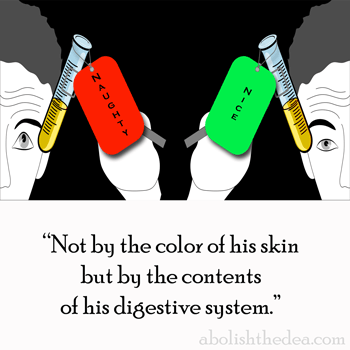
Here's a political cartoon that the New Yorker magazine would not touch with a 10-foot drug-testing kit.
So I'm not going to apologize for discussing the details of my antidepressant use – at least not until Walmart apologizes for selling games that encourage irresponsible drinking26. But the readers of such essays should ideally know my final takeaway conclusion on the whole topic: namely, that there are a lot of common sense ways to get off of antidepressants – or at least ways that have a prima facie chance of working if one considers psychological common sense. Once we permit ourselves to fight drugs with drugs27, we can imagine the strategic (yes, and wise) use of a wide variety of substances to make withdrawal actually WORK for a drug like Effexor! So, when I'm sitting at the top of my stairs, wishing that I were dead because of the withdrawal downsides, I could employ cocaine, or MDMA, or any of a wide variety of phenethylamines, etc. etc. to obfuscate and transcend the blues. Note that I do not say that any one of these drugs would necessarily work, but psychological common sense tells us that a drug that inspires and elates could help buoy our mood during Effexor withdrawal and so help us "stay the course" without backsliding. Indeed, how could such drugs NOT help, unless Effexor has mucked up our brain chemistry in a truly irreparable way, which would itself be an important finding of such an experimental protocol in any case, assuming that the pharmaceutical companies which pay for drug research these days would allow that fact to become known among the general public28. Unfortunately, materialists do not employ common sense when it comes to drugs. Remember, these are the guys who don't even think that laughing gas could help the depressed!
So the take-home message for my readers regarding getting off of antidepressants is the following: that there are psychologically obvious things to try that could actually make getting off drugs like Effexor POSSIBLE! – and yet these common-sense protocols are all given a double whammy by our drug-hating society: first these protocols are outlawed by pharmacologically clueless politicians, and then our materialist doctors gaslight us by insisting that such substances had no proven ability to help us in any case!
So my (so far) final word on the subject is this: I do not advocate any specific methodology for getting off of antidepressants (which I'm told would be a horrible no-no even though Americans feel free to recommend a stiff shot of alcohol for whatever ails us) – I merely call for the use of common sense when approaching the problem of drug withdrawal. If getting off the Big Pharma drugs makes one feel down, then, for God's sake, let's give the withdrawing individual something to lift them UP!!! This is not rocket science, folks – or at least it wasn't until modern psychologists adopted the cold-hearted ideology of behaviorism.29.
NOTE: No wonder medical professionals want us to see a doctor to get off of antidepressants. When you go to the doctor who prescribed them in the first place, the doctor is going to spin the story such that the drug itself is never the villain of the piece -- let alone the mad policy of drug prohibition, which shunted one off onto the massively dependence-causing Big Pharma "med" in the first place. Besides, they know that such withdrawal never even works for long-term users, and the doctor will be there when the "patient" falls to welcome them back into the pill-taking faith: the faith in the endless beneficence of modern science! We may be dependent for life -- but we can always take comfort in the realization that we have been rendered dependent on a purely scientific basis! As Lady Teazle reminds us in School for Scandal: "One must not be out of the fashion!"
Before we begin, a nod to our benefactors: The Drug War Philosopher website is sponsored by The Partnership for a Death Free America, which reminds you to 'just say no' to godsend medicines! The Partnership for a Death Free America: promoting harebrained and ultimately racist hysteria since 1971!
I feel the need to write a new site introduction every few months given the new insights that I am constantly acquiring as I philosophically parse America's unprecedented and hateful attitude toward psychoactive substances. Studying this topic is like peeling back the layers of an onion, one which appears fresh enough at the supermarket but which is found to contain increasing amounts of soft rot when one gets it home and subjects it to culinary scrutiny. Although my seven years of research on this topic has never persuaded me to take back a word of what I have written thus far in protestation of the inhumane policy of drug prohibition, it does occasionally provide me with new, more pithy argumentation – and/or ways to drive home a point that I have already made but in passing. I have already shown, for instance, how drug prohibition outlaws my right to heal as a chronic depressive. It seeks to "save me" from becoming dependent upon opium and cocaine by shunting me off onto Big Pharma meds that are much, much harder to kick than heroin, and some of which – like the Effexor I am on – cannot be kicked at all, except by 5% of the population of long-term users – and even those are likely to find that they have cognitive impairment after so doing3031. Had I fully appreciated the pernicious ramifications of these facts before writing what follows, I would have begun by first "outing" myself as a chronic depressive and then showing how the outlawing of cocaine denies my right to heal while simultaneously turning me into a lifetime patient and a ward of the healthcare state. I would have pointed out how the outlawing of opium brings about a similar disempowerment for so-called pain patients, denying them the right to heal and forcing them to rely on the healthcare state – to decide FOR them how much pain relief they need and when – not based solely on the patient's perception of pain, as such judgments should be made, but based instead on the doctors' estimates of what they can "get away with prescribing," considering that the bureaucrats in Washington will be second-guessing their decisions based on an ad-hoc collection of puritanical and political biases of their own32.
I would have then pointed out that the Drug Warrior gets away with this only because they never consider the depressed and the suffering to be stakeholders in the drug re-legalization debate. They instead focus the debate on the potential misuse of panaceas by white American young people whom they refuse on principle to teach about safe drug use. I would then point out how the propaganda thus generated has bamboozled even our most liberal drug-reform advocates. Take Wade Davis, for instance, a writer for Rolling Stone magazine. In his 2025 article on "The Secret History of Coca,33" Freud knew that cocaine was a godsend for the depressed. But doctors saw it as a threat to their bottom line and so they studied only the rare misuse of the drug.
Wade implies that cocaine was justifiably outlawed because doctors encountered 400 cases of toxic cocaine use worldwide. 400! He implies that this fact provides a knock-down argument for cocaine prohibition. Wade forgets however that 49,000 Americans commit suicide every year – 49,00034 -- and many of those deaths occur because America has demonized and outlawed drugs like cocaine and laughing gas – both of which could cheer up the suicidal in a TRICE! In a TRICE! Wade forgets, moreover, that alcohol KILLS 178,000 a year in America alone35. 178,000! In other words, both Drug Warriors and their dupes are completely bamboozled – they are completely unable to make a fair cost/benefit analysis of drug use. Why? Because they ignore all stakeholders except the white American young people whom we refuse to educate about safe drug use. These bamboozled pundits have no concern for the users who, because of drug prohibition, are being sold unregulated product at unknown doses and hence dying in American streets! These pundits, in fact, are blind to ALL downsides of drug prohibition. They do not see how America's unprecedented wholesale outlawing of psychoactive drugs has destroyed minority communities around the globe, abolished the rule of law in Latin America, trashed the U.S. Bill of Rights, and led to the election of America's first would-be fascist as President of the United States thanks to the use of drug law to arrest millions of minorities, thereby removing them from the voting rolls, either on a de facto or a de jure basis. Now, that's blindness36!
In fact, if I were to rewrite this introduction today, I would begin by proclaiming the obvious takeaway message from the above two paragraphs: namely, that drug prohibition is nothing less than a crime against humanity . And yet I have so far enumerated but a fraction of the seemingly endless reasons why this is so. The open-minded site visitor is therefore invited to learn more by reading the following – and to browse my ever-growing collection of essays as I continue to hold the Drug Warriors responsible for the endless crimes for which the vast majority of Americans are more than willing to give them an enormously hypocritical "Mulligan."
I conclude this preface with two relevant quotations from "Our Right to Drugs" by Thomas Szasz 37:
"The laws that deny healthy people 'recreational' drugs also deny sick people 'therapeutic' drugs."
"More often than not, the effective treatment of pain requires neither clinics nor doctors, but only a free market in drugs. However, such pharmaceutical freedom would make our highly paid pain researchers and pain clinicians unnecessary and unemployed."
The introduction proper
Well, pull up a chair and sit down, pardna! Let me tell you what this here website is all about. But first, let me tell you a little about yours truly. I am the Drug War Philosopher and founder of abolishthedea.com, one Brian Ballard Quass by name. I am not a board-certified philosopher, but I am a lover of wisdom and so I make so bold as to use the appellation. Last time I checked, it had not been trademarked. If it makes you feel any better, though, I was offered a job as a TA in the philosophy department of Virginia Commonwealth University back in 1989, but I turned it down. I did not realize at the time that by so doing, I was giving my ideological opponents of the future an excuse to pretend that I did not exist.
Truth be told, however, my lack of tenure actually makes me MORE of a philosopher than my board-certified counterparts. Why? Because I am able to speak truths that they could only speak on pain of losing their jobs!
Take the subject of laughing gas , for instance. The FDA recently decided that they were going to regulate that substance as a 'drug.'38 Now, as a philosopher, I knew that it was the use of laughing gas , nitrous oxide, that had inspired the ontology of William James. I knew, moreover, that James had conjured us as philosophers to study the effects of such substances in 'The Varieties of Religious Experience.'
'No account of the universe in its totality can be final,' wrote James, 'which leaves these other forms of consciousness quite disregarded.39'
So I was appalled at the FDA's efforts to treat N2O as a drug and so make it even less available to the public than it already was.
But guess what happened when I tried to alert board-certified philosophers to this pending injustice? Not one of them responded. Not one. You would have thought that at least the Harvard philosophers would have been up in arms, since James founded the Harvard Psychology Department. But not a bit of it. In fact, James's use of laughing gas and related substances is not even mentioned in Harvard's online biography for James. They have censored James's life and philosophy in deference to the sensibilities of the Drug War. And so they dishonor William James in the same way that the Jefferson Foundation dishonored Thomas Jefferson. It will be remembered that the latter organization invited the DEA onto Monticello 40 in 1987 to confiscate the founding father's poppy plants, in violation of everything that he stood for, politically speaking. Actually, it probably will NOT be remembered, because the Drug War is all about censorship -- the selective censorship of facts whose publication might encourage Americans to rise up against the War on Drugs.
So I tried my luck 'across the pond' and wrote individual letters on this subject to every single philosopher at Oxford University -- every single one of them -- and not one of them responded41. Not one.
Americans are childish about drugs. We blame our problems on inanimate objects and burn other countries' plants so that we can feel safe at home. We need to grow up and learn to use nature's bounty wisely for human benefit.
And so when the FDA called for public comment on their attempts to demonize laughing gas , I was the only philosopher in the entire world who wrote in to protest the proposed action in the name of academic liberty.
And so it seems to me that my outsider status is a plus, not a negative.
But why do I even care, you probably ask? What does it have to do with ME, you probably wonder?
Well, I'm glad that you probably asked those questions, because guess what? I have skin in this game. Drug prohibition has affected me personally.
But soft, you shall hear!
You see, I am a 66-year-old chronic depressive who realized five years ago that the Drug War had been depriving me of godsend medicine for a lifetime and that it had shunted me off instead onto dependence-causing Big Pharma drugs, drugs for which dependence, indeed, was a feature, not a bug42. So I determined to track down the premises upon which such an inhumane policy was based and to expose the false assumptions that seemed to justify it in the minds of the masses. In other words, I decided to approach the subject of the Drug War and substance prohibition from a philosophical point of view.
I soon realized that the injustices of the Drug War were hidden in plain sight everywhere, but that I had been brainwashed by drug-war ideology not to see them. Take laughing gas again, for instance. In a sane world, nitrous oxide would be made available to the suicidal in portable kits, in the same way that we give epi pens to those with severe allergies. In fact, I soon realized that any 'pick-me-up' substance could be used as an antidepressant, or at least as one part of a mood-elevating protocol. And yet the DEA scheduling system tells me that such drugs have no positive uses whatsoever, this despite the fact that some of these substances had inspired entire religions in the past and were considered panaceas by all ancient physicians. Clearly, some false assumptions were at play here that no one was acknowledging, and that is where philosophers should come in. It is their job to identify false assumptions. Sadly, however, most board-certified philosophers are asleep on the job when it comes to the Drug War. It is clearly more than their jobs are worth to speak up on this subject. This explains why 100 of America's most well-known philosophers ghosted me when I sent them a 16-page thesis on these topics: not one of them even acknowledged receipt43.
I soon found that the problematic assumptions of the Drug War did not just come from 'the great unwashed,' however, but that the assumptions of materialists were giving a veneer of 'science' to Drug War lies44. Take the lie, for instance, that most psychoactive drugs have no positive uses whatsoever. This is clearly just a prejudiced belief based on the unspoken Christian Science assumptions of the poorly educated, but the materialists find themselves agreeing with this absurd statement, albeit for their own unique reasons. They believe that the true causes of human behavior are to be found under a microscope, and so it is okay to ignore both anecdotes and history when it comes to drug use. They are dedicated to the inhumane philosophy of Behaviorism. And so the fact that a drug cheers you up and gives you something to look forward to means nothing to them. The fact that you laugh under the influence of laughing gas means nothing to them45. They are after the Holy Grail of a materialist 'cure' for your depression. They do not want to simply make you laugh and feel good. They have a much higher metaphysical ambition in mind: they want to create a 'REAL' cure for you.
And what is the result of this materialist hubris? One in four American women are dependent upon Big Pharma drugs for life - while we yet outlaw drugs that have inspired entire religions.
In 'The Concept of Nature,' Alfred North Whitehead tells us that:
'The substantial reason for rejecting a philosophical theory is the 'absurdum' to which it reduces us.'46
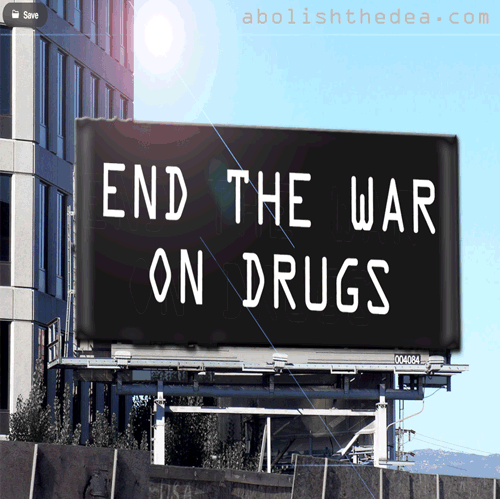
Here is a billboard you might see in a free country in which the narrative is not controlled by conglomerate media.
The absurd consequences just noted clearly show us then that it was a category error to have placed materialists in charge of American drug policy and research in the first place. The true experts in these fields are what I call pharmacologically savvy empaths, those shaman-like individuals who have used the drugs in question and who know something about human motivation and aspirations in the vocational, psychological, and spiritual realms. Materialist scientists may tell us of physical dangers associated with specific dosages of specific substances, but they have no expertise whatsoever in deciding if drug use passes a risk/benefit test for a given person. Such judgment calls must be made by the potential users themselves in light of their goals in life, their philosophy of life, and their risk tolerance given their own particular circumstances.
And so we see that materialists and Drug Warriors conspire to keep us from any obvious treatments for our depression and anxiety. As a lifelong victim of this absurd mindset, I can only say, 'Thanks for nothing, guys!!!'
Nor is it just the anxious and depressed who suffer. Many of the drugs that we have outlawed can inspire spiritual states, as William James well knew. So the fact that we have outlawed drugs means we are outlawing religions - and not just a specific religion, either, but the religious impulse itself. Drug prohibition is thus unconscionably evil. It not only controls what we can think, but how and how much we can think. It is the greatest and most intimate degree of totalitarianism imaginable. The outlawing of opium, in particular, was an enormous power grab by government. It put government in charge of doling out pain relief.
As Jim Hogshire wrote in 'Opium for the Masses':
'The poppy's central and indispensable position in our civilization makes access to it important, and thus forbidding public access to the poppy is staggeringly cruel.'47
And then there's the racial angle of substance prohibition. Racist politicians have passed bills to remove minorities from subsidized housing if they fail to pass drug tests. This is racist in the extreme. To see this clearly, do a little thought experiment. Imagine that Congress had passed a law to give drug-tests to middle-class white women and planned to deny them Social Security payments if they tested positive for oxy or valium. One cannot imagine such a thing. Congress would never pass such a law because the Drug War is all about punishing minorities, not 'respectable' white women. If that latter population misuses a drug, they are thought to demand our compassion and help - whereas we kick minority 'substance abusers' out of their houses. This is horrific racism, and yet Americans are blinded to the injustice thanks to the immensely hypocritical fearmongering and substance demonization of the War on Drugs. It could not be clearer, however, that substance prohibition is ultimately just an excuse to disempower minorities, in a world in which more overt forms of racism are still considered more or less unacceptable48.
This should not come as a surprise, however. Drug prohibition has always been about cracking down on minorities. Opium was outlawed thanks to fearmongering about Chinese influence in America, cocaine thanks to fearmongering about Blacks, and marijuana thanks to fearmongering about Hispanics. Harry Anslinger helped bring about the death of Billie Holiday by harassing her over her use of heroin 49, not because Harry was interested in her well-being but because he wanted her to stop singing songs that made white America uncomfortable.
I hope you are starting to get a sense of why I am devoting my 'twilight years' to attacking the War on Drugs. It is a hydra-headed injustice that causes all of the problems that it purports to solve, and then some. It is the reason why America is now a dictatorship of the ignorant - because the Drug War has thrown millions of liberal minorities into jail, thus removing them from the voting rolls and ensuring the election of card-carrying Drug Warriors.
Let's think about movies , for a minute. Think of all the most violent films and scenes of torture. Most of them involve drug dealing. Sadly, these movies 50 only reflect reality, and yet no one realizes that it is substance prohibition which brought this vicious dystopia to life! Prohibition incentivizes hugely profitable illicit drug dealing, and this empowers the amoral to be as evil as they want to be51. 60,000 have been 'disappeared' in Mexico since 2006, and yet that astounding fact is never blamed on the War on Drugs, which created all that violence and death out of whole cloth! No one is willing to connect the dots52.
The Drug War and prohibition will never end, however, as long as we fail to hold it responsible for the deaths and heartache that it causes, like the drive-by shootings in America's inner cities. Today's clueless reporters attribute such violence to things like global warming and lack of jobs - to anything, in fact, but to drug prohibition, which armed the hood to the teeth in the first place.
As Anne Heather Thompson wrote in the Atlantic in 2014:
'Without the War on Drugs, the level of gun violence 53 that plagues so many poor inner-city neighborhoods today simply would not exist.'
And yet Lisa Ling produced an hour-long special on violence in Chicago, without even MENTIONING the War on Drugs54.
Do you see now why I created this website? Someone's got to say this stuff.
In a sane world, there would be Drug War programs at major universities where the assumptions and injustices of the prohibitionists would be held up to educated scorn55. One class would discuss the outlawing of religion implicit in drug criminalization, another would trace the psychiatric pill mill 56 to the monopoly that Big Pharma 5758 received from substance prohibition, still another would show how reductive materialism 59 lends a veneer of 'science' to Drug War injustice, yet another would concentrate on the violence and hard feeling that substance prohibition has needlessly introduced into the world. There would also be courses covering the heretofore ignored fate of the millions who suffer in silence thanks to the under-prescription and/or outlawing of godsends and who are never considered as stakeholders in the drug-related debates sponsored by demagogue politicians. But for now, that's just a dream. The tide of willful ignorance has not yet turned. And so in the meantime, all I can do is set a principled example for a more educated and less brainwashed posterity.
American conservatives claim to be outraged by government control, yet the government controls the most important thing in their life: how they are allowed to think and feel by outlawing godsend medicines.
This leads us to another unrecognized problem of the Drug War: it has censored both science and academia in general60. The scientific censorship can be seen in magazines like 'Scientific American' and 'Psychology Today,' where they write supposedly definitive articles about emotions and consciousness while ignoring the insights that drug use provides us on such subjects. 'Science News' magazine recently promoted a new kind of shock therapy for depression, which they told us was a difficult condition to treat61. But depression is difficult to treat only if we assume that psychoactive drugs do not exist. There are hundreds of drugs that could end depression for a user in a heartbeat - most notably, perhaps, the many phenethylamines synthesized by Alexander Shulgin62, but also opium63 and coca64. And none of these drugs force us to risk damaging the brain to attain our ends.
I have frequently written to magazines that dogmatically ignore references to 'drugs,' asking them to end their censored articles with a disclaimer, such as: 'The author has written in fealty to the Drug War ideology of substance demonization and has thus ignored the insights that drug use might provide on this topic.' The author's conclusions are often just wrong unless one assumes such a disclaimer. But, as with most of my drug-related correspondence, I never receive a response. I guess that the editors assume that their readers are just as brainwashed by Drug War ideology as are their writers, and so no one is likely to hold the magazine responsible for their self-censorship when it comes to drugs.
And it's not just scientists who censor themselves in the age of the Drug War. Almost every non-fiction book either ignores drugs or speaks of them disparagingly - as if it makes sense to subsume a vast array of completely unique substances under the dismissive classification of 'drugs.'
Take the book by historian Ronald Hutton entitled 'The Witch: A History of Fear from Ancient Times to the Present.65' Like most academics, Ronald has nothing good to say about drugs. He only mentions them once in his book, when he likens them to the fatal brews created by so-called service magicians on behalf of murderers. What he does not realize, however, is that the 'herbs' that he's forever referencing in his book are drugs! The word may sound gentler and more homey than 'drugs,' but clearly the 'herbs' he mentioned were used as psychoactive agents. To claim that herbs are different than drugs, at least in this context, is like claiming that 'meds' are different than 'drugs.' The only substantive difference, however, is that the former are promoted as good by the Drug Warrior and the latter are demonized as evil. The distinction is an irrational one based on fearmongering.
Nixon's domestic advisor, John Ehrlichman, admitted in a 1994 interview that the Drug War was a campaign against Blacks and war protestors. 'Did we know we were lying about the drugs? Of course we did,' said Ehrlichman.
Hutton's failure to see this is unfortunate, because his whole book is about strategic fearmongering by the powers-that-be, and the Drug War is the most notorious example of strategic fearmongering in the history of the world66.
But you see what I'm up against, right? The whole world has gone mad with the prohibitionist mindset - with the possible exception of a few indigenous tribes that we westerners have not yet dispossessed and killed for failing to embrace a drug-free Christianity.
And believe me, I have only begun to list the downsides of the War on Drugs and substance prohibition. I have written hundreds of essays on drug-related topics over the last five years and I am still spoiled for choice when it comes to new angles to pursue in demonstrating the inhumanity and imbecility of the prohibitionist mindset.
The Drug Warrior has taught us to fear drug use in a way that we fear no other potentially dangerous activity on earth: not mountain climbing, not SCUBA diving, not tightrope walking, not drag-racing - not even car driving or beer drinking67. This is strategic fearmongering, however. Its goal is to deprive Americans of democratic freedoms by erecting the boogieman of 'drugs,' one which is nevertheless far less threatening in actuality than the many dangerous activities that we allow freely and even promote. We have the Drug War to thank for the destruction of our rights under the 4th amendment, for suppressing our freedom of religion 68, and for all but outlawing free and honest speech about drugs - something that is unconscionably suppressed these days by media of all kinds. We have, in fact, the Drug War to thank for Donald Trump and the end of American democracy.
And yet Americans slumber on.
It is easy to become depressed. The finish line keeps getting kicked further into the future, until one suspects that it will take a dose of armageddon 69 for the world to re-evaluate drugs from the indigenous point of view, to realize that they are our friends and that we should learn how to use them wisely for the benefit of individuals and communities, rather than superstitiously demonizing them a priori.
Strategic fearmongering is the enemy, and until that fact is realized, the Drug Warriors will continue destroying what's left of democracy around the world, leading to all sorts of unnecessary violence and suffering as they do so.
And Americans in particular should know better. Liquor prohibition created the Mafia, after all.
Meanwhile, any social policy that relies on ignorance rather than education should be abhorrent to freedom-loving people around the world. These are just a few of the reasons why I say that the Drug War is not just bad policy, but that it represents a wrong way of looking at the world, one which causes all of the problems that it purports to solve and then some.
Conclusion
The list of problems with the Drug War mindset goes on and on and so I have to end this introduction somewhat arbitrarily. To simplify matters for the reader, however, let me close with an apothegm that says it all:
The Drug War is based on two enormous lies: 1) that there are no upsides to drug use, and 2) that there are no downsides to prohibition.
Author's Follow-up: January 28, 2025
There is an additional reason that I am devoting my twilight years to ending the hateful War on Drugs, and that is because my job in so doing is AI-proof. Artificial intelligence can never deal with the world's drug biases -- except perhaps tyrannically, by imposing its own supposedly logical 'viewpoint' on the world. For the 'viewpoint' of any AI app with respect to a philosophically fraught subject is a product of the algorithm that created it and the assumptions upon which that algorithm was coded. You can be sure, moreover, that coders will be under ongoing pressure to ensure that their AI algorithms are productive of politically correct output when it comes to the Drug War.
Self-medicating is just a pejorative term for taking care of one's own psychological health. Doctors demonize the practice for obvious financial reasons.
Philosophy, in general, is one field that AI can never conquer, except via ideological fiat. Such a technological triumph would always be guilty of the logical fallacy of petitio principii: it would presuppose the correctness of many of the highly debatable principles upon which such supposed preeminence would be both justified and based.
I recently asked an AI app what William James would have thought about the proposed outlawing of laughing gas . The app told me that he might have suggested that laughing gas be made available for philosophers only under special circumstances. But this answer is clearly based on modern Drug War ideology and not on James's views. James was a fan of Benjamin Paul Blood's work on anaesthetic revelation. Blood held that the mystic insights derived from the use of substances like laughing gas 70 should be available to all people -- that they were educational and beneficial in and of themselves. To say that James would have wanted these revelations withheld from the average person is to impose modern drug-war biases on the past.
Author's Follow-up: March 13, 2025
I was racking my brains this morning, trying to figure out why Americans would support drug prohibition in spite of all the problems that it has caused and which it continues to cause as outlined above. They apparently think that drug prohibition saves lives, but this is simply not true. The Drug War causes far more deaths than it saves -- 60,000 deaths of innocents in Mexico alone over the last two decades, tens of thousands of deaths in American cities every year -- meanwhile destroying the rule of law in South America and destroying the 1st and 4th amendments to the U.S. Constitution here in the States.
But even if the Drug War did cut down on deaths, it would not make sense. We do not forbid horseback riding nor liquor consumption on the grounds that less people would die in a horse-free or a liquor-free world. Why not? Because we value freedom more than we do a death-free world. And yet horseback riding is the leading cause of traumatic brain injury in the United States. And liquor kills 178,000 a year per the CDC. This is something that even many drug reformers do not understand: that the Drug War not only does not work but that it SHOULD not work. No one should use drug law to dictate how and how much we should be allowed to think and feel in this life.
There is nothing wrong with crutches. Hubristic materialist science set out to 'cure' human sadness, and what is the result? 1 in 4 American women are now dependent on Big Pharma drugs for life.
It is time for Americans to grow up and accept the fact that the world is, and will always be, full of psychoactive substances. That's the way the world is. And our way to deal with that fact should be to educate, not to incarcerate. incarceration 71 makes literally no sense, given that drug use has a raft of positive potential benefits and that such use has even inspired religions. It follows that the arrest for drug use is an enormous injustice. It is the injustice par excellence for it comes between us and our emotions and tells us what we are allowed to feel and what we are not allowed to feel in this life.
Before the American prohibitionists showed up, the tyrant could only outlaw things -- but the prohibitionist tyrants are far more ambitious: they outlaw new feelings and ideas by outlawing the substances that can inspire them. They not only tell us how the world must be but they tell us how we must feel about things in our innermost heart of hearts. It is the ultimate tyranny. This is why I always laugh when I see the Virginia license plates that read 'Don't tread on me,' knowing that the vast majority who own such plates are perfectly happy to have the government control their pain relief and to tell them what thoughts and feelings they are even allowed to entertain. 'Yeah, right,' I say, 'don't tread on you? Brother, they are treading you into the dust even while you're driving around town flaunting your supposed freedom.'
And here we come to another problem with the Drug War. At the risk of offending any libertarians in my readership, I must say that Drug Warriors are skinflints who refuse to spend a dime on social programs. What they do not realize, however, is that they ARE spending money on social programs -- billions, in fact. Or rather they are spending billions on anti-social programs, programs which they call law enforcement and corrections. They are spending billions so that the DEA and local police forces can deal with drug-related healthcare problems via the penal system -- thanks to which bizarre non-sequitur America now has the highest per capita incarceration 72 rate in the world. They are spending billions so that the police can handle our healthcare problems when it comes to psychoactive medicine. This is insanity and yet most Americans seem to think that this is how a freedom-loving country should handle their healthcare problems: by arrest.
The 1980's version of Life gave you a Life Card for saying 'no' to time-honored panaceas and medicines that have inspired entire religions -- aka 'drugs.'
Imagine if we redirected the billions we give the DEA to Head Start programs and to the top-notch education of the poor in inner cities. That would be the real way to combat problematic drug use: by teaching people, not just about safe drug use, but teaching people in general. But the Drug Warrior loves ignorance. They actually believe it is wrong to be honest with people about drugs. In a sane and free world, this fact alone would laugh them off the stage of public opinion. And yet this is a mainstream view in Drug War America. Bill Clinton once claimed that his brother would not be alive were cocaine 7374 legal. What he failed to realize was that tens of thousands had to die in inner cities so that his brother could 'survive' -- and that Americans had to lose the 1st and 4th amendments to the Constitution so that his brother could 'survive' -- and that poor inner-city women had to be evicted from their homes via drug testing 75 so that his brother could survive -- and that the rule of law had to disappear in Latin America so that his brother could survive -- and that 60,000 had to go missing in Mexico alone over the last two decades so that his brother could survive.
And why did the Drug Warriors recently demand the re-criminalization of drugs in Oregon? Because they refused to spend one single penny on helping those people transition to a normal life while using drugs as safely as possible. In fact, they even arrested those who tried to help users to use safely. This is ironic because before drug prohibition, the opiate user was a member of society, smoking an opium pipe peaceably at home at night. But the Drug Warriors were not satisfied with the status quo, so they criminalized opium and forced opiate users onto the streets -- and now they are griping about the fact that opiate users are on the streets. One can only conclude that they believe the opiate users should be on Mars.
A sane person is tempted to restate the maxim of biologist JBS Haldane as follows:
'Not only is the Drug War stranger than we imagine, but it is stranger than we CAN imagine.'
That is why so few critics of drug criminalization understand the full evil of the War on Drugs. It is not a good idea that did not work: it is a demonstrably bad idea that SHOULD never work, not in any society that values freedom of religion 76, freedom of conscience, and freedom of academia.
Author's Follow-up: March 19, 2025
FYI: When I use the term "Drug War" in my essays, I am usually not speaking merely of Nixon's War on Drugs but rather the Drug War that I maintain has been going on at least since the 19th-century in American society, as manifested by the popular desire to hold substances responsible for behavior. This puritanical crusade began as a religious movement against liquor -- but when the Carrie Nations of the world failed in their goal to outlaw liquor for all time, they turned all their moral outrage toward pretty much every other less dangerous psychoactive substance on earth. This is all part of the "Drug War" ethos, as I understand such terms, or what you might call "the spirit of prohibition," which, like a master criminal, has gotten away with causing endless suffering without ever being identified as the villain of the piece. The Drug War is thus the ultimate "gorilla in the room" -- a gorilla that has been ignored so long by media and politicians that most people no longer think it even exists -- hence their failure to hold it responsible for the endless evils that it propagates: such as inner-city violence, the destruction of the rule of law in Latin America, and the silent suffering of millions thanks to the outlawing of godsends.
And why are these godsends outlawed? It is because of the inhumane doctrine of the Drug Warrior, which tells us that a substance that can be misused by white American young people when used in one context for one reason at one dosage must not be used by anyone in any context for any reason at any dosage. A more hateful doctrine cannot be imagined upon which to base a system of mental health.
Author's Follow-up:
April 17, 2025
I am always looking for better, more pithy arguments to convince a thoroughly brainwashed world that its views about "drugs" are all wrong. This week, I had an epiphany that provided me with one such argument which goes straight to the heart of the matter. It occurred to me that phrases like "Fentanyl 77 kills" (or "PCP 78 kills" or "Oxy kills" or "Crack kills"...) are exactly like the phrase "Fire bad!" All such phrases are based on the following assumption: namely, that a substance that can cause problems when used by a white young person at one quantity in one situation cannot be used wisely by anyone at any quantity in any situation. Had humankind maintained that jaundiced view of fire, we would still be living in the Stone Age today.
In such a world, people like myself would be insisting that fire has good uses -- and we would be shouted down. The mainstream would fire back with indignant retorts like the following: "You wouldn't say such things, Og, if your family had been killed by fire like MINE has!"
To oppose the Drug War philosophically, one has to highlight its connections to both materialism and the psychiatric pill mill. And that's a problem, because almost everyone is either a Drug Warrior or a materialist these days and has a vested interest in the continuation of the psychiatric pill mill.
Orchestras will eventually use psychedelics to train conductors. When the successful candidate directs mood-fests like Mahler's 2nd, THEY will be the stars, channeling every known -- and some unknown -- human emotions. Think Simon Rattle on... well, on psychedelics.
If we cared about the elderly in 'homes', we would be bringing in shamanic empaths and curanderos from Latin America to help cheer them up and expand their mental abilities. We would also immediately decriminalize the many drugs that could help safely when used wisely.
The drug war is the defeatist doctrine that we will never be able to use psychoactive drugs wisely. It's a self-fulfilling prophecy because the government does everything it can to make drug use dangerous.
Drug warriors abuse the English language.
News flash: certain mushrooms can help you improve your life! It's the biggest story in the history of mycology! And yet you wouldn't know it from visiting the websites of most mushroom clubs.
Cop and detective shows are loaded with subtle drug war propaganda, including lines like, "She had a history of drug use, so..." The implication being that anyone who uses substances that politicians hate cannot be trusted.
Westerners have "just said no" to pain relief, mood elevation and religious insight.
In his treatise on laws, Cicero reported that the psychedelic-fueled Eleusinian Mysteries gave the participants "not only the art of living agreeably, but of dying with a better hope."
In an article about Mazatec mushroom use, the author says: "Mushrooms should not be considered a drug." True. But then NOTHING should be considered a drug: every substance has potential good uses.